Today Scrum is everywhere, from small development shops to multinational corporations. Over the last 33 years it's become the major software development framework or methodology (depending on your perspective) driving product development throughout the globe. That's about to change. Software Engineers are already in the middle of a career crisis with the astronomical investment costs in AI and prediction of its supernatural powers. C-Suite executives (i.e. people) are making the decision they soon won't need the highly paid expertise of software engineers any longer (or at least much less). Professionals throughout the tech industry are wondering if we've hit bottom, and if not yet, then when. Here's the bad news. A second wave is about to upend the entire software development process, and it will hit like an extinction level event.
Here's our take. We won't soften it.
Welcome to on: DevOps, the newsletter from DevOpspolis for engineers, managers, and leaders who build, ship, and operate software at scale.
We're here because the DevOps conversation deserves better than vendor noise and conference theater. Every issue you'll get a short, opinionated take on something that actually matters. And views which are practical, experienced, and honest.
What you can expect from us:
- Real insight from people who've operated production systems, not just written about them
- Strong opinions, held loosely. We'll state our position, show our reasoning, and listen
- Actionable thinking, and practical solutions, not textbook theory. We've been there
- No agenda except to be useful to you
We're not here to tell you what you want to hear. We're here to tell you what we think is true.
Now. Back to the question.
"An extinction level event."
Scrum was built for another time, to solve yesteryear's problems. It was designed for human clock cycles not GPU ones. Iterations were a pushback to gain stability from constantly changing requirements. Story points were a quick way to plan scope. The daily standup - to ensure everyone is in the loop. Definition of Done - focus on delivering customer value, not checking off tasks. All good efforts to address real-world development issues. All fall flat in an AI Centric world.
Scrum as well as other methodologies have long been showing their age. Story pointing is considered waste by the #noestimates community. Daily Standups, or SUMs as they're sometimes called, are often not daily, and usually no one is standing. These are adjustments made trying to fit Scrum to today's reality of remote, globally distributed teams. To top it off, today's communication tools have enabled, and sometimes forced, us to shed many of the restrictive Scrum rituals. AI will shatter the rest. It will be an extinction level event.
"Rituals become barriers"
Scrum has rituals. Prescriptive to create consistency, reliability, and predictability. Take two iterations call me in the morning rituals. Rituals are the cookbook approach to baking a cake. Repeat these steps and out comes the expected result. But when ovens, stoves and cookware changed the recipes needed to adapt. When microwaves appeared they couldn't just adjust the time, or quantity, they cooked differently from the inside out. So the process of cooking changed. Now with Sous vide, it's changed yet again. Not just the mechanics, but the "toss away your cookbook" type of change. If not tossed aside when they no longer serve their purpose, rituals become barriers.
Scrum's rituals are synchronous, slow, and life draining. I've never met a developer that after several years of daily stand-ups is still excited and looking forward to the next one? In an AI centric world they are no longer needed. What was once an aid to delivery became a weight as development began moving faster than the sprints. What used to take several sprints and a two-pizza sized team, can now be completed by one person in a day. That's not just a higher velocity, it's a fundamental shift on how work gets done.
A fact lost on many Executive teams is that software development is both engineering and art. Engineering requires rigor and discipline. Art requires freedom and spontaneity. Imposed rituals kill creativity. How many engineers would rather be in a planning meeting than in "the flow". Guess which one is more productive. AI development processes can adapt to the customer, company, industry, individual, and day of week. In the new Agentic development world maybe your personal agent attends the stand-up instead of you. Faithfully providing status and offering help to other agents when needed.
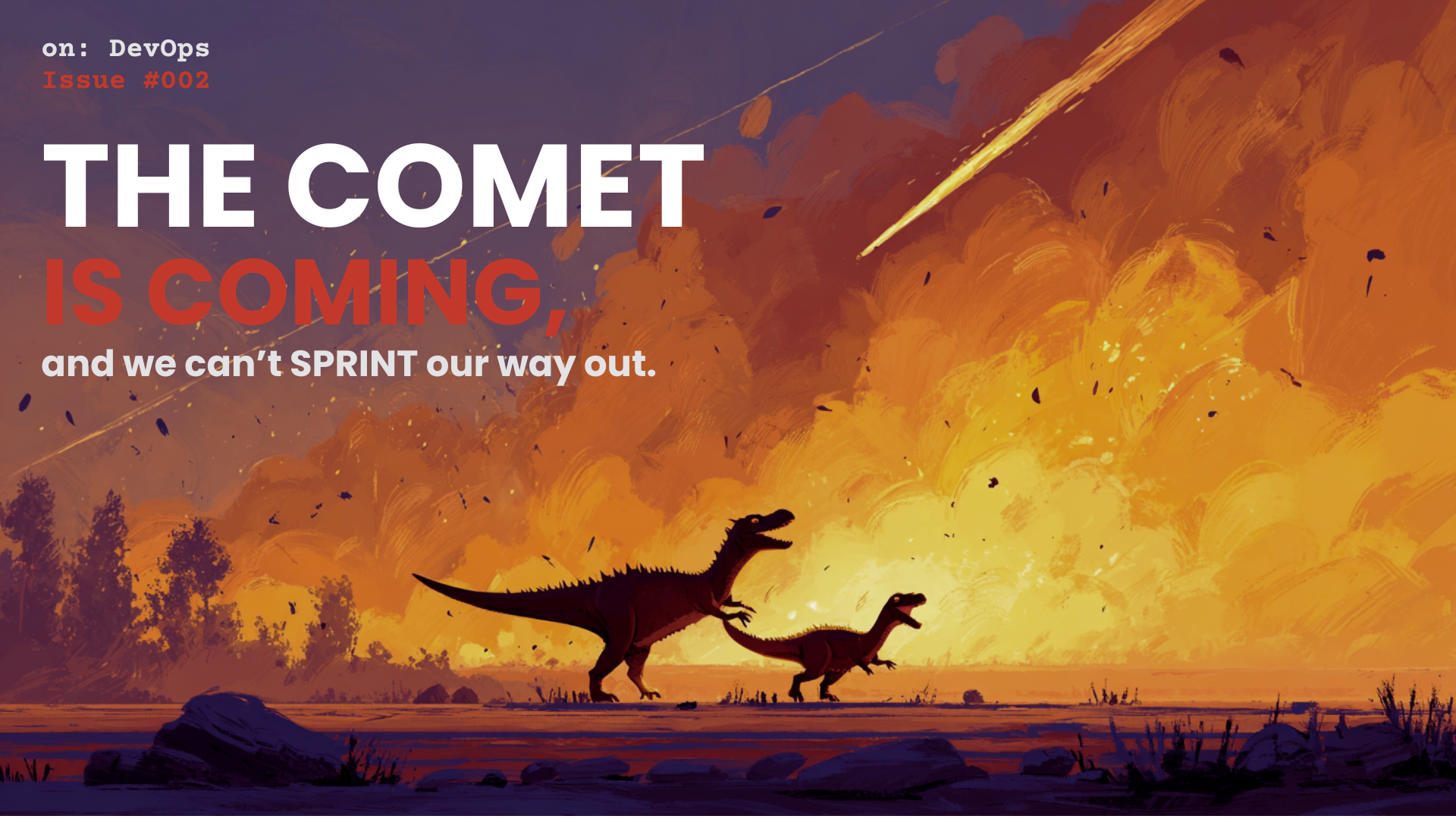
"The comet is coming. It won't wait for sprint planning."
While asynchronous communication tools changed how information moves through organizations, AI has changed how fast software can actually be produced. Sprints were calibrated for human throughput. That calibration is broken. Scrum is broken.
When an engineer working with AI can produce in a day what once took a sprint, the two-week iteration doesn't just feel slow. It becomes actively obstructive. You finish the work, and then wait. You wait for the sprint review. You wait for the planning session. You hold onto the completed feature because the ceremony demands it. You're force-fitting the output of a jet engine into the timing belt of a bicycle. Teams that hold onto the comfort of Scrum won't be able to keep up with those using AI-powered development. The teams looking up will see the comet is coming. It won't wait for sprint planning.
"All models are wrong, but some are useful." - George E. P. Box
The statistician George E. P. Box famously said: "All models are wrong, but some are useful." Scrum was a useful model for the problem it was designed to solve, in the time it was designed to solve it. The problem is we stopped treating it as a model and started treating it as a standard. We started trying to force fit teams and innovation into a factory assembly line model designed for reliability producing the same widgets repeatedly. That's not what software development is about. It's trying to create the first widget not the nth. In doing so we forgot the first half of the quote. All models have flaws. So it shouldn't be surprising that Scrum isn't the best tool for a changed problem. Some elements already exist in business process automation tools which are currently getting an AI jet pack strapped to them.
"Go West, young man" - Horace Greeley
It took years for Agile and Scrum to build the professional support industry which exists today. I fear it will soon collapse. The highly trained, experienced and professional ScrumMasters, Trainers, and Industry experts will get hit hard in this second wave. My best advice is to "Go West". Try to stay up to date or ahead of the latest industry trends. There will be a dry spell when jobs and job titles vanish, and many false starts for new technology when it fails to "cross the chasm". Things will change, but the complexity, and explosion of new products will require guides to help companies find their way through the overwhelming options in their path. Technical guides in specialized domains will be needed to assist companies in making the technology choices which are best suited for them.
"The best way to predict the future is to invent it" - Alan Kay
Even better than trying to predict the future is to create a piece of it. The ability for a single person to create something end-to-end is closer than it's been for many decades. Learn AI, figure out which problems it solves, and which it creates. Experiment, fail, learn.
The future has changed. Now go change the future.
We'd love to hear from you. Let us know what topics you'd like to hear by sending email on-devops@devopspolis.com.
If this one landed, share it with someone who needed to hear it, and follow us on LinkedIn
on: DevOps by DevOpspolis — Practical. Experienced. Opinionated.